What is the 3-Flash Rule? 2026 Guide to WCAG 2.3.1 Compliance
- What is it? A safety rule for websites and videos. It says that content should not flash more than three times in any single second to prevent seizures.
- Why it matters? Quick flashing can trigger a seizure in less than a second, giving a person no time to look away.
- What counts as a "flash"? A sudden change in brightness (getting much brighter and then darker) or rapid transitions involving saturated red.
- Is it a legal requirement? Yes. Under the Americans with Disabilities Act (ADA), public and government-funded organizations in the U.S. must follow this safety standard.
The WCAG 2.3.1 "Three Flashes or Below" rule is a Level A safety standard. It requires that web content does not flash more than three times in any one-second period. A flash is defined as a pair of opposing changes in relative luminance of 10% or more, where the darker image has a relative luminance below 0.80. This protects people with photosensitive epilepsy by keeping visual stimuli below known biological triggers.
#The Science of Visual Safety
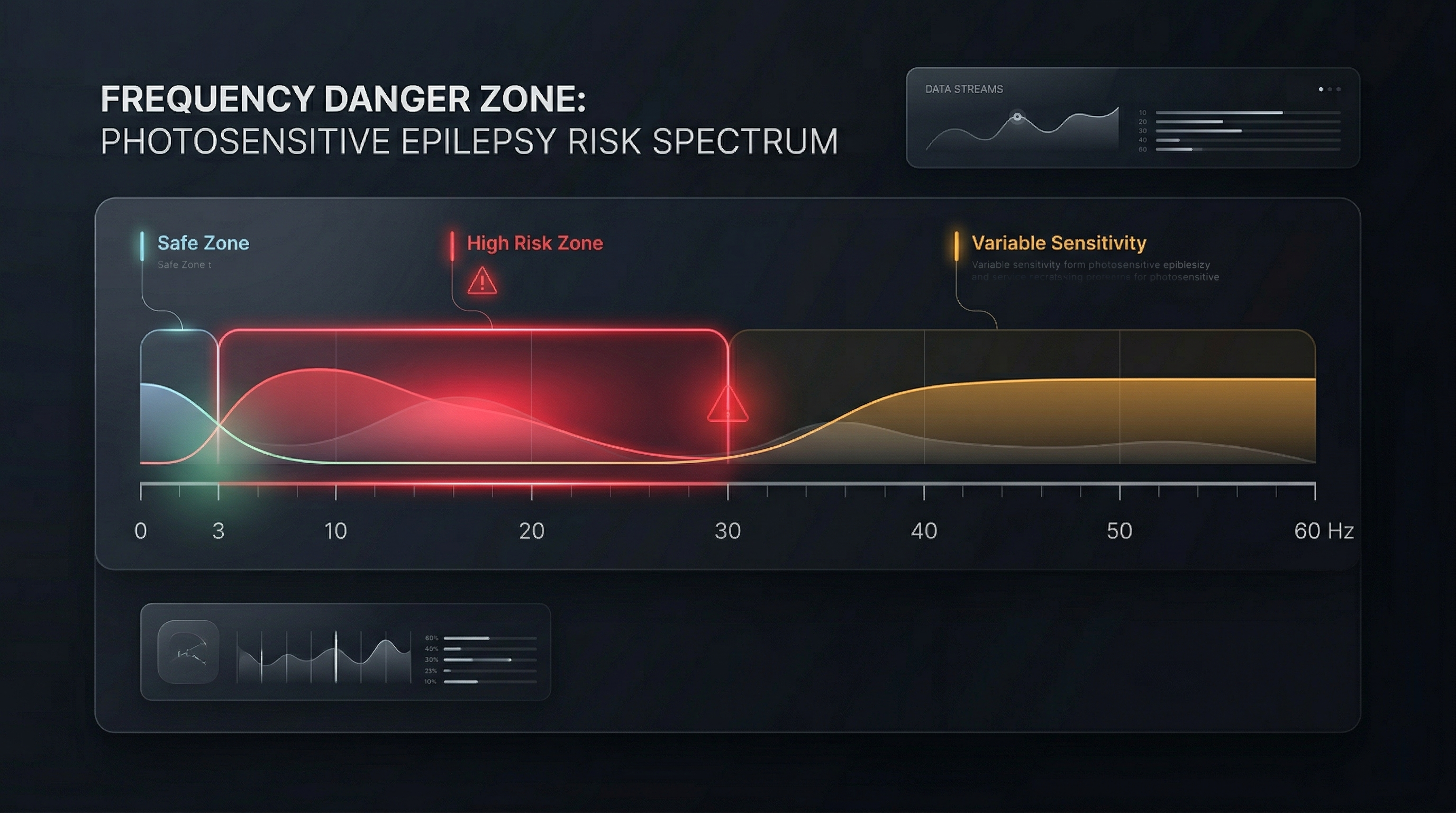
Photosensitive epilepsy (PSE) is triggered when the brain’s visual cortex is overstimulated by rhythmic stimuli. Flashing between 3 and 30 Hertz (flashes per second) is most likely to trigger seizures, though this varies by person. While some are sensitive up to 60 Hertz, sensitivity under 3 Hertz is rare. Because neural synchronization can trigger a seizure in less than a second, users cannot simply look away from violating content.
Because of this, WCAG 2.3.1 is a non-interference requirement. A single violating element makes the entire page non-compliant, as the health risk is immediate.
#Technical Requirements of WCAG 2.3.1
To achieve Level A compliance, content must follow specific mathematical limits for frequency, luminance, and color.
#1. The Three-Flash Limit
A flash is defined as a pair of opposing changes in relative luminance () of 10% or more, provided the relative luminance of the darker image is below 0.80.
- Frequency: Content must not flash more than three times within any rolling one-second period.
- Luminance Calculation: Relative luminance is determined using the sRGB formula: .
#2. Defining a "Flash"
The human visual system is highly sensitive to saturated red light. A saturated red transition occurs if:
- One state in the transition meets .
- The transition exceeds a chromaticity difference of 0.2 units in the CIE 1976 UCS diagram.
#3. The Spatial Exception (Steradians)
Content may be exempt if the flashing area is smaller than 0.006 steradians. This is about 25% of any 10-degree visual field. However, on high-density mobile displays or VR headsets held close to the face, even a small pixel area can exceed this safety limit.
#Generative AI Video: Safety Risks
The rise of generative AI video introduces new risks of visual instability. Unlike human-edited video, AI models can produce:
- Pixel-level Shimmering: Quick brightness fluctuations between frames.
- Strobing: Rapid lighting transitions as models reconcile training data.
- Color Shifts: Sudden changes in color saturation that can accidentally trigger red flash thresholds.
#Compliance and Implementation
As of April 2026, the Department of Justice finalized the ADA Title II update, making WCAG 2.1 Level AA the explicit standard for public entities.
| Entity Type | Population Served | Compliance Deadline |
|---|---|---|
| Large Public Entities | 50,000 | April 24, 2026 |
| Small Public Entities | 50,000 | April 26, 2027 |
| Special Districts | Any | April 26, 2027 |
#Verification and Remediation Strategies
Checking by eye is not enough to catch 10% luminance shifts. Instead, organizations must use automated tools like the Harding FPA or video-audit.com.
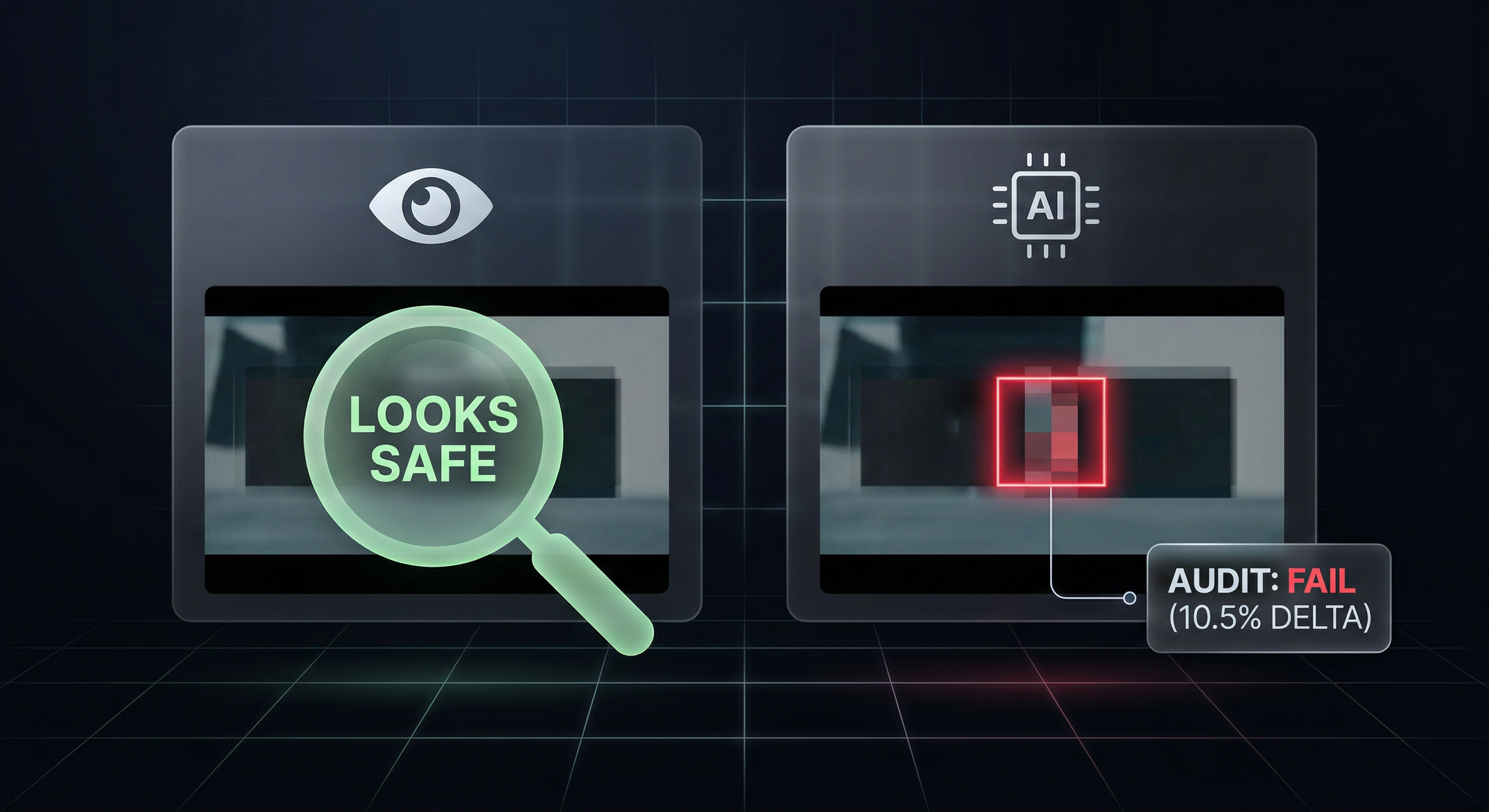
If content fails, you can fix it by:
- Reducing Contrast: Darkening the bright frames or lightening the dark frames to keep the difference below 10%.
- Frame Rate Interpolation: Adding intermediate frames to smooth transitions.
- Global Suppression: Using
prefers-reduced-motionmedia queries to let users turn off animations.
#Conclusion
The 3-flash rule is an essential safeguard. By following these rules for frequency and luminance, organizations ensure that their digital content is safe for all users. In the current regulatory environment, proper verification is the only way to meet Level A compliance and protect the well-being of the photosensitive community.
#Frequently Asked Questions (FAQ)
If even a single element on a web page or within a video violates the WCAG 2.3.1 threshold, the entire page is considered non-compliant because the risk of inducing a seizure is immediate.