Photosensitive Seizure Standards Compared: WCAG, Ofcom, ITU, NHK, and ISO
- Most regulatory standards restrict flashing to three or fewer transitions per second and limit saturated red transitions to prevent reflex seizures.
- Television broadcast standards evaluate flash areas across the entire display, whereas web standards assess localized visual fields (a 10-degree cone).
- Use WCAG for web and mobile software, Ofcom or NHK for regional broadcast delivery, and ITU-R BT.1702 or ISO 9241-391 for global streaming and hardware display pipelines.
For people with photosensitive epilepsy (PSE), rapid flashes, repeating geometric patterns, and abrupt saturated color shifts can trigger epileptic seizures. To prevent harmful content from reaching screens, international standards bodies and broadcast regulators maintain formal technical specifications.
Because these rules were authored across different eras and display technologies, ranging from cathode ray tube (CRT) television to high dynamic range (HDR) mobile displays, their mathematical models and measurement units differ significantly.
This comparison outlines the technical differences across the major standards, their mathematical thresholds, and how to determine which framework applies to your distribution pipeline.
#Applicable Standards by Industry
Selecting the correct standard depends on your distribution medium and regulatory jurisdiction:
#1. Web, Mobile, and Digital Software
- Standard: W3C WCAG 2.1 / 2.2 Success Criterion 2.3.1 (Level A).
- Scope: Websites, mobile apps, SaaS platforms, streaming interfaces, and digital advertising.
- Regulatory context: WCAG serves as the legal baseline for public and commercial accessibility laws, including ADA Title II/III in the United States and the European Accessibility Act.
#2. UK and European Television Broadcast
- Standard: Ofcom Guidance Note on Flashing Images and Regular Patterns in Television (2017).
- Scope: Linear commercial television, cable networks, and UK-licensed on-demand services.
- Regulatory context: UK broadcasters require an automated test certificate (such as a Harding FPA report) before master assets can clear commercial transmission.
#3. Japanese Television and Anime Production
- Standard: NHK and JBA Joint Guidelines for Flashing Images (2020 revision).
- Scope: Television programming, commercial spots, and animation produced or licensed for broadcast in Japan.
- Regulatory context: Formulated after the 1997 Pokémon broadcast incident, these rules place strict limits on rapid scene cuts, inverted colors, and high-frequency strobing in animated content.
#4. Global Video Distribution and Streaming
- Standard: Recommendation ITU-R BT.1702-3.
- Scope: Global streaming platforms, encoding pipelines, and content syndication.
- Regulatory context: Major streaming platforms use BT.1702 as a delivery baseline. Netflix, for example, mandates BT.1702 testing for original animated and high-risk live-action master deliveries.
#5. Display Hardware, Gaming, and VR Systems
- Standard: ISO 9241-391: Ergonomics of human-system interaction.
- Scope: Display panel manufacturing, video game engines, console platforms, and VR headsets.
- Regulatory context: Focuses on physical display ergonomics, viewing distance assumptions, and interactive 3D rendering environments.
#Technical Differences Explained
While all five frameworks protect viewers by keeping visual stimulation below the brain's 3 Hz to 30 Hz seizure danger zone, they calculate flash hazards using different mathematical formulas:
#1. Relative Luminance versus Absolute Luminance
- WCAG calculates relative luminance () from normalized sRGB color values on a 0.0 to 1.0 scale. A flash occurs if opposing transitions reach or exceed 10% relative luminance and the darker state is below 0.80.
- Ofcom, ITU, and NHK measure physical luminance in candelas per square meter (). They flag a flash when transitions exceed and the darker frame is below (calibrated against a reference white of ).
#2. High Dynamic Range (HDR) Handling
Standard SDR guidelines assume a maximum display peak of . For HDR video with peak brightness reaching or higher, absolute deltas would trigger false positives on minor contrast shifts. To solve this, ITU-R BT.1702 and NHK apply Michelson contrast for bright frames, flagging transitions where the contrast ratio exceeds (approximately ).
#3. Saturated Red Transitions
The human retina is especially sensitive to long-wavelength red light because it excites L-cones without triggering balanced inhibition from M- and S-cones. WCAG and ISO calculate saturated red states using: Transitions into or out of this state are flagged if chromaticity distance exceeds 0.2 units on the CIE 1976 UCS diagram:
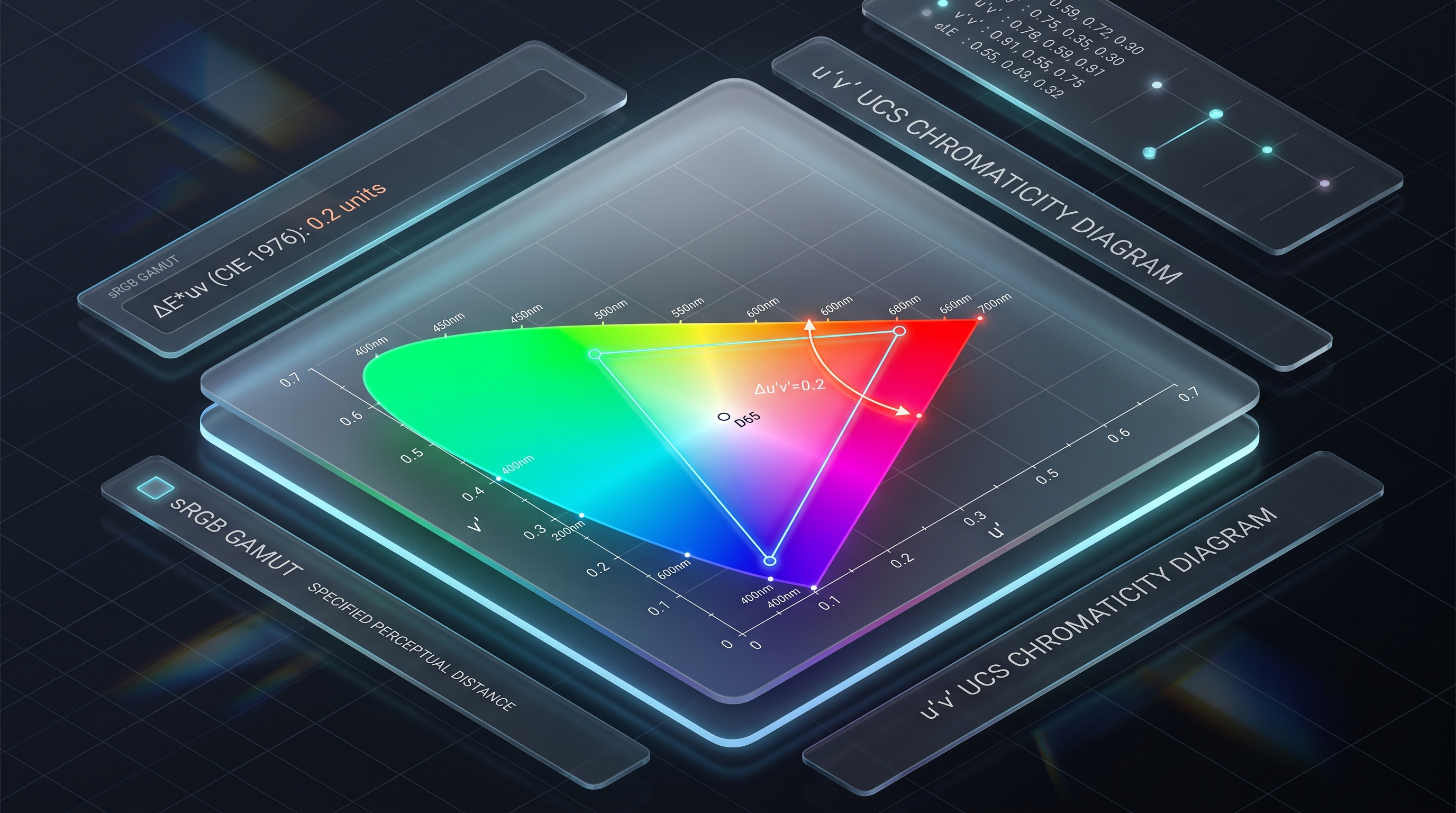 Figure 1: CIE 1976 UCS diagram showing the red-flash safety margin.
#Core Standards Comparison Matrix
The table below summarizes the key technical parameters across the five major regulatory frameworks:
| Standard / Guideline | Primary Domain | Max Safe Flash Rate | Minimum Brightness Change (SDR) | Spatial Size Limit | Saturated Red Definition |
|---|---|---|---|---|---|
| W3C WCAG 2.2 | Web & Software | flashes/s | relative luminance change | 25% of a visual field ( subarea) | with CIE UCS shift |
| Ofcom 2017 | UK Television | flashes/s (exempt if spaced ) | change (if darker state ) | 25% of total screen area | Restricted, qualitative guidance |
| NHK/JBA | Japan Animation | flashes/s (allows for low-contrast cuts) | analog IRE change | 25% of total screen area | Restricted, filter-based suppression |
| ITU-R BT.1702 | Telecom & Video | flashes/s (exempt if spaced ) | change (uses Michelson Contrast in HDR) | 25% of total screen area | Restricted, general precautions |
| ISO 9241-391 | Displays & Hardware | flashes/s (flashing is safe) | change | 25% of total screen area | with CIE UCS shift |
Sources: W3C WCAG 2.2, Ofcom Broadcast Code, JBA Animation Guidelines, ITU-R Recommendations, ISO Standards, and comparative analysis from Jordan & Vanderheiden (2024).
#Automated Multi-Standard Verification
Because delivery requirements vary by distribution channel, manual calculations across thousands of frames are impractical. Video Audit executes multiple compliance profiles simultaneously in WebAssembly, evaluating relative luminance, Michelson contrast, and saturated red metrics within your browser to verify delivery readiness across web, streaming, and broadcast specifications.
#Frequently Asked Questions
The human visual system is biologically more sensitive to deep, long-wavelength red light. Red light stimulates long-wavelength sensitive cones in the eye without triggering the standard inhibitory mechanisms from medium and short-wavelength cones, making red-blue or red-dark flashing a much higher seizure trigger risk.
#References & Sources
- J. Bern Jordan and Gregg C. Vanderheiden. 2024. International Guidelines for Photosensitive Epilepsy: Gap Analysis and Recommendations. ACM Transactions on Accessible Computing. https://doi.org/10.1145/3694790
- World Wide Web Consortium (W3C). Web Content Accessibility Guidelines (WCAG) 2.2. Success Criterion 2.3.1 (Three Flashes or Below Threshold).
- Office of Communications (Ofcom). 2017. Guidance Note on Flashing Images and Regular Patterns in Television.
- International Telecommunication Union (ITU). 2023. Recommendation ITU-R BT.1702-3: Guidance for the reduction of photosensitive epileptic seizures caused by television.
- International Organization for Standardization (ISO). 2016. ISO 9241-391: Ergonomics of human-system interaction, Part 391: Requirements, analysis and compliance test methods for the reduction of photosensitive seizures.