Harding FPA vs Video Audit: Modern Photosensitive Seizure Testing for Digital Video
- Different jobs: Harding FPA is built for television broadcast master control rooms. Video Audit is built for web video, social media ads, streaming platforms, and digital agencies.
- Cost model: Harding test bureaus charge £30 to £45+ every single time you submit a video file. Video Audit lets you run unlimited checks on your own device for free, with predictable flat-rate plans for automated batch queues and certified compliance reports.
- More standards: Harding tests broadcast rules (Ofcom and ITU). Video Audit runs Ofcom, ITU, WCAG 2.2 (2.3.1), Trace24, and ISO 9241-171 in a single scan.
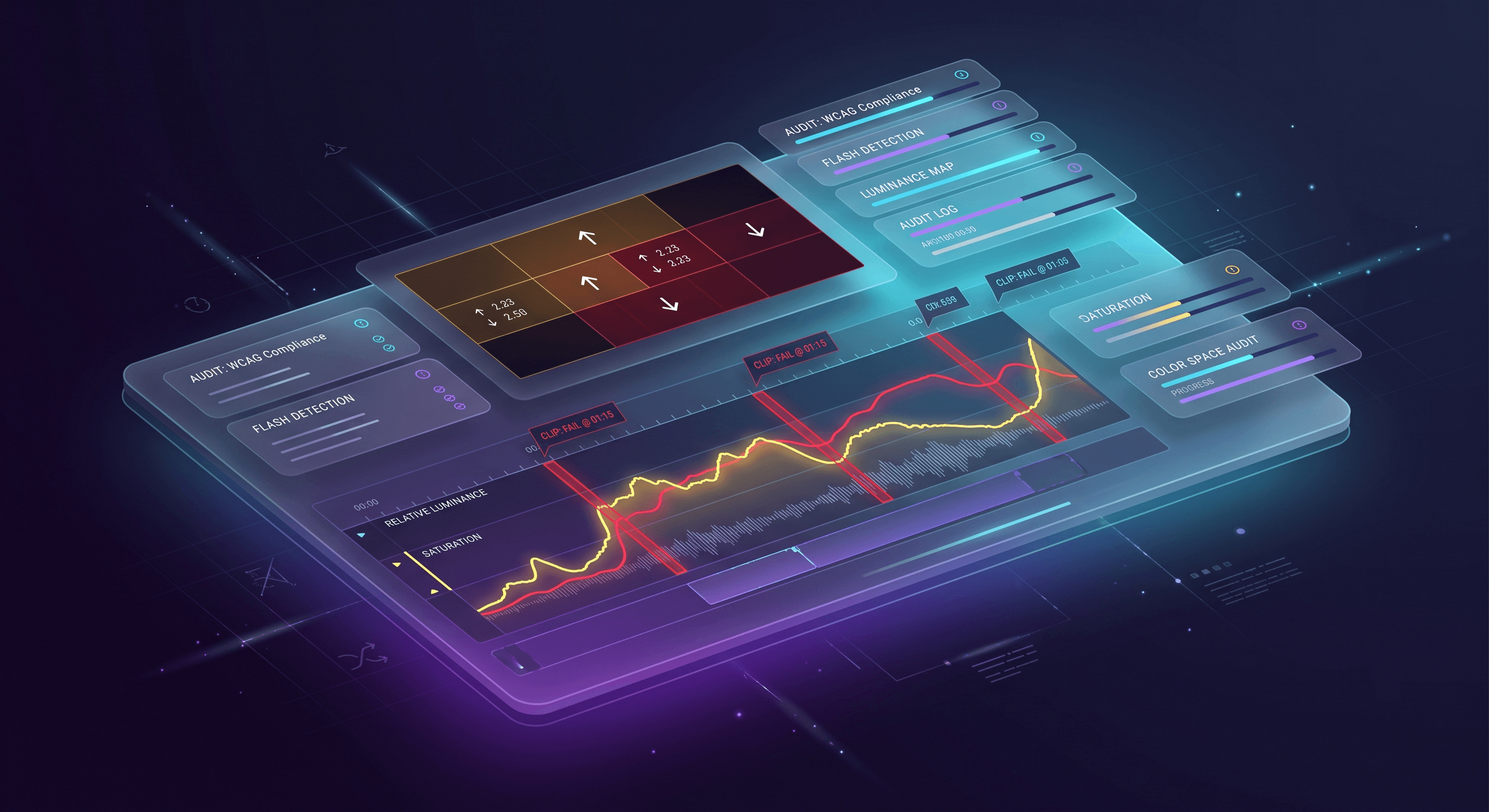
- Immediate feedback: Instead of waiting hours for an email report from a bureau, Video Audit spots failures in real time and marks offending pixels directly on your video frames.
If you work in television in the UK or Japan, you know the Harding test well. For decades, networks like the BBC, ITV, and Channel 4 have required a clean Harding Flash and Pattern Analyser (FPA) certificate before any commercial or show can air. It is the established benchmark for television broadcast delivery.
However, video production has changed. Marketing teams, digital agencies, game studios, and corporate communication departments produce hundreds of short-form videos every month for TikTok, Instagram Reels, YouTube, and corporate portals.
Video Audit was built for these faster digital turnarounds, analyzing videos directly on the editor's machine without fees per revision.
#How Harding FPA and Video Audit compare
| Feature | Harding FPA | Video Audit |
|---|---|---|
| Target Media | Linear television broadcast | Web, social media (TikTok/Reels), video ads |
| Cost Model | Pay-per-file (£30 to £45+) or £1,500+ licenses | Free on-device tier; flat-rate plans (pricing) |
| Execution | Hardware dongle or bureau cloud upload | Client-side WebAssembly (no upload) or Cloud API |
| Standards | Ofcom 2017, ITU-R BT.1702, NAB-J | 5 standards in 1 run: WCAG 2.2, Ofcom, Trace24, ITU, ISO |
| Formats | ProRes, DNxHD, MXF broadcast masters | MP4, WebM, animated GIFs, 9:16 vertical video |
| Turnaround | Hours (queue-based bureau delivery) | Instant (real-time on-device processing) |
| Remediation | Static PDF pass/fail report | Interactive timeline with 16×12 hazard grid |
| CI/CD & API | Broadcast QC add-on (Telestream, Interra) | Native REST API and headless CLI runner |
#How broadcast and web standards differ
Passing a broadcast television test does not mean a video complies with web standards.
Broadcast guidelines and web guidelines measure visual stimulation differently because people watch television screens and mobile phones in very different ways.
#1. Ofcom and ITU-R BT.1702 (television standards)
Broadcast guidelines assume a viewer sitting in a living room, roughly 9 screen heights away from a television set:
- They measure flashes between 3 Hz and 30 Hz.
- They check absolute luminance jumps of 20 candelas per square meter () on calibrated television monitors.
- They flag saturated red flashes and regular geometric patterns (such as repeating stripes) covering more than 25% of the screen.
#2. WCAG 2.2 Guideline 2.3.1 (web standard)
The Web Content Accessibility Guidelines apply to phones, tablets, and desktop monitors. Because people hold phones only 25 to 30 cm from their eyes, the screen occupies a much larger angle in their vision:
- Relative luminance: WCAG checks relative contrast shifts () when the darker frame is under 0.80.
- 10-degree field of view: Flashes cannot cover more than 25% of any 10-degree visual cone. A phone screen viewed up close easily covers that entire 10-degree window.
- Saturated red transitions: Strict chromaticity formulas in the CIE 1976 Uniform Chromaticity Scale where red content exceeds .
Harding FPA focuses on broadcast specifications. Video Audit evaluates both broadcast rules (Ofcom, ITU) and web rules (WCAG, Trace24) simultaneously, confirming whether a video passes for both television and online publication in a single test.
#Bureau fees compared to monthly software
If your team produces video on a regular basis, pay-per-test fees add up quickly.
Pay-Per-Test Bureau Model
£35 to £45+
The Revision Penalty: Every time an editor adjusts a cut and re-exports, you must pay another £35 to £45 fee.
Modern Web Platform
Built for Digital
Free On-Device + Flat Plans
Unlimited Re-Testing: Tweak transitions, re-export, and re-scan instantly on your own machine without paying anything extra.
Explore Pricing & Features →
#When to use Harding FPA
Harding FPA is an established tool with decades of engineering behind it. You should use it if:
Your broadcaster contract requires it
Commercial television networks in the UK (ITV, Channel 4, Sky) and Japan contractually mandate an official Harding FPA certificate before ingesting commercials and broadcast masters.
You work in linear television post-production
If your deliverables are high-bitrate ProRes 422 HQ, Avid DNxHD, or MXF files going into television master control rooms, Harding remains the recognized broadcast standard.
You already pay for enterprise broadcast QC suites
If your facility already runs enterprise broadcast ingest software like Telestream Vantage or Interra Baton with an active Harding license, your pipeline is already paid for.
#When Video Audit fits better
Video Audit fits modern digital workflows where speed, multi-standard coverage, and low cost matter:
Digital agencies and social media teams
Short-form video ads on TikTok, Instagram Reels, YouTube Shorts, and web banners need instant verification before campaigns launch, without paying bureau fees per revision.
Enterprise web and accessibility teams
Organizations preparing for ADA Title II enforcement (requiring WCAG 2.1 AA) can verify online videos and animations directly in their browser without uploading sensitive pre-release media.
Motion designers and game creators
Editors can see the exact frame coordinates of light strobes and camera flashes on a 16×12 grid, make a quick adjustment in their timeline, and re-check instantly with zero turnaround delay.
Software platforms with user-uploaded video
Engineering teams can integrate our REST API or headless CLI directly into their encoding pipelines to automatically flag or reject flashing media before it reaches users.