Photosensitive Seizure Standards Compared: WCAG, Ofcom, ITU, NHK, and ISO
- General Safety Limits: Most safety rules state that video content should not flash more than three times per second, nor display highly saturated red transitions, to protect people with photosensitive epilepsy.
- Different Rules for Different Screens: Television broadcasts usually measure flashing over the entire screen area, while web standards focus on a smaller, localized visual area (the 10-degree field of view).
- Which Standard is Right for You? Select WCAG if you are designing websites or web apps. Choose Ofcom, ITU, or NHK if you create television broadcasts. Rely on ITU or ISO if you develop display hardware, gaming consoles, or virtual reality systems.
For individuals with photosensitive epilepsy (PSE), encountering rapid flashing lights, bold geometric patterns, or high-contrast color transitions on a screen can trigger reflex seizures. To prevent this, various international organizations have established safety guidelines.
Because these standards were created for different media, ranging from analog television to web browsers, they can be confusing to navigate.
This guide breaks down the major international standards, helps you identify which one applies to your project, and explains how they compare technically.
#Which Standard is Relevant for You?
Depending on the type of content you are building and where it will be viewed, you should follow specific standards:
#1. Web, App, and Software Creators (W3C WCAG)
- Relevant Standard: WCAG 2.1 / 2.2 Success Criterion 2.3.1 (Level A)
- Use Case: Websites, mobile apps, SaaS platforms, online advertising, and digital documents.
- Why it matters: WCAG is the global baseline for digital accessibility laws (like ADA Title II in the U.S. and the European Accessibility Act). Meeting this criterion ensures your web media is safe for a diverse online audience.
#2. European and UK Television Producers (Ofcom)
- Relevant Standard: Ofcom 2017 Guidance Note on Flashing Images
- Use Case: Commercial broadcast television, cable networks, and video-on-demand services operating in the United Kingdom or distributing to European networks.
- Why it matters: Compliance is a legal requirement enforced by Ofcom. Television shows and commercials must pass specialized screening (like the Harding Test) before they can be aired.
#3. Japanese Broadcasters and Animators (NHK/JBA)
- Relevant Standard: NHK / JBA 2020 Joint Guidelines
- Use Case: Television programs, commercials, and animated content produced or broadcast in Japan.
- Why it matters: Established following a highly publicized 1997 cartoon broadcast incident, these guidelines enforce strict limits on strobe flashes, rapid cuts, and high-frequency animations common in anime.
#4. Video Engineers and Streaming Platforms (ITU-R)
- Relevant Standard: Recommendation ITU-R BT.1702
- Use Case: Global video distribution pipelines, codecs, and major streaming platforms like Netflix.
- Why it matters: ITU-R BT.1702 is the mandatory delivery baseline for major platforms. For example, Netflix explicitly requires BT.1702 compliance testing for all original animated and anime productions (and high-risk live-action content) before master package submission.
#5. Hardware, Display, and Game Developers (ISO)
- Relevant Standard: ISO 9241-391
- Use Case: Display panel manufacturers, virtual reality (VR) headsets, gaming console software, and interactive video game developers.
- Why it matters: This standard focuses on screen ergonomics, ensuring that hardware display rendering and interactive gaming pipelines minimize photosensitive risks.
#Technical Differences Explained
While all guidelines aim to keep flashing rates below the human brain's natural seizure-triggering frequencies (typically between 3 Hz and 30 Hz), they apply different mathematical models:
#1. Relative vs. Absolute Brightness
- WCAG uses relative luminance () calculated from sRGB color space values ( to ). A flash occurs if the relative brightness changes by 10% or more and the darker frame has a value under 0.80.
- Ofcom, ITU, and NHK use absolute physical brightness measured in candelas per square meter (). They look for a brightness change of or more when the darker state is under (assuming standard indoor white is set to ).
#2. High Dynamic Range (HDR)
Traditional guidelines assume a maximum screen brightness of . For bright modern HDR displays, ITU and NHK apply Michelson Contrast for bright frames. A transition is flagged as a hazard if the contrast delta exceeds 1/17 (approx. 0.0588).
#3. Saturated Red Flashes
The human eye is biologically more sensitive to red light because it stimulates the retina's red cones without triggering the balancing neural inhibition from green and blue cones. WCAG and ISO define a saturated red state mathematically if: A transition to or from this state is a violation if the colors differ by more than 0.2 units on the CIE 1976 UCS diagram (shown below).
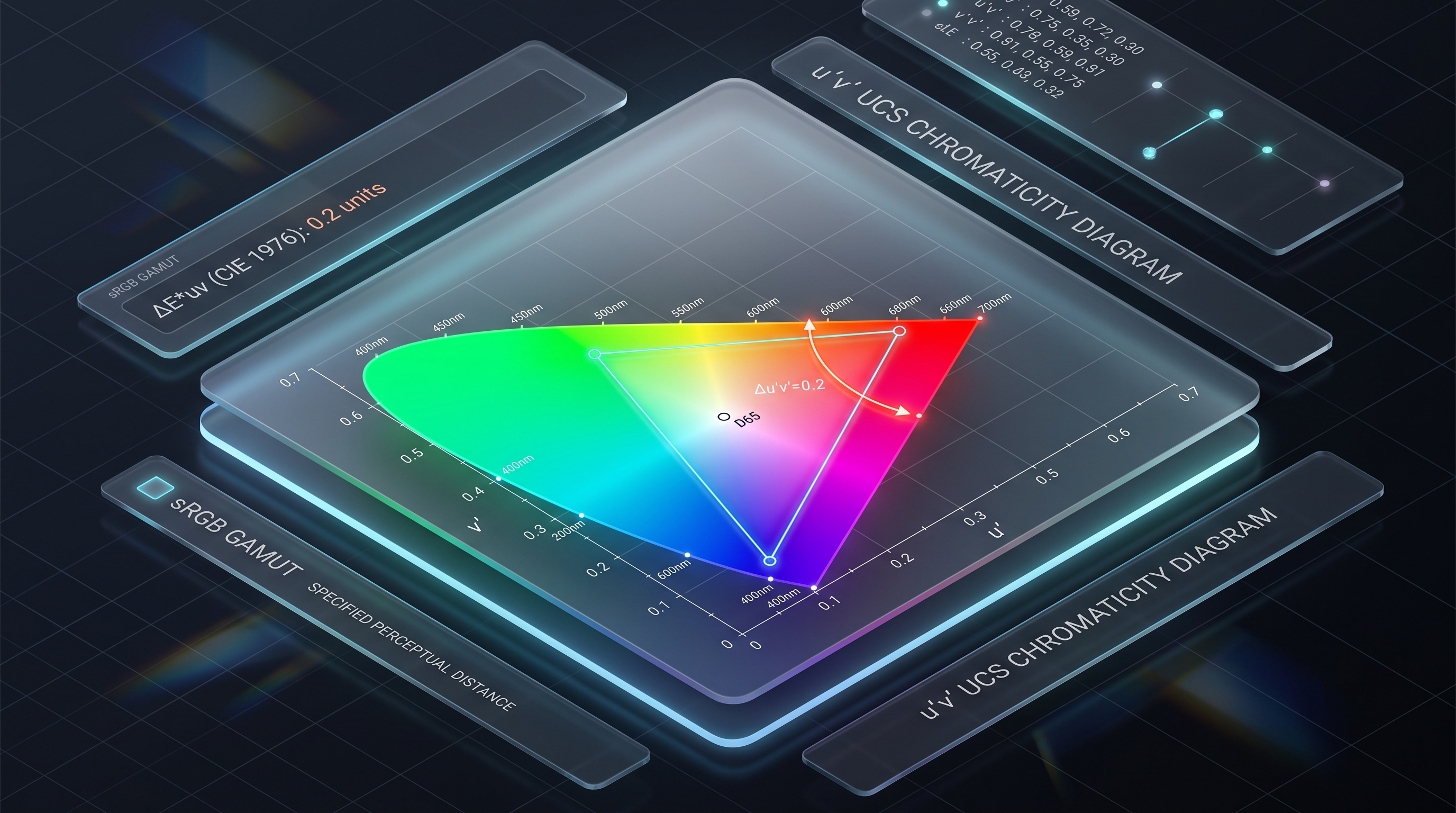 Figure 1: CIE 1976 UCS diagram showing the red-flash safety margin.
#Core Standards Comparison Matrix
To help you navigate these specifications, the table below maps out the key differences across the five major standards.
Note: Technical parameters are synthesized from the respective regulatory documents and academic analysis.
| Standard / Guideline | Primary Domain | Max Safe Flash Rate | Minimum Brightness Change (SDR) | Spatial Size Limit | Saturated Red Definition |
|---|---|---|---|---|---|
| W3C WCAG 2.2 | Web & Software | flashes/s | relative luminance change | 25% of a visual field ( subarea) | with CIE UCS shift |
| Ofcom 2017 | UK Television | flashes/s (exempt if spaced ) | change (if darker state ) | 25% of total screen area | Restricted, no mathematical formula defined |
| NHK/JBA | Japan Animation | flashes/s (allows for low-contrast cuts) | analog IRE change | 25% of total screen area | Highly restricted, handled with special filters |
| ITU-R BT.1702 | Telecom & Video | flashes/s (exempt if spaced ) | change (uses Michelson Contrast in HDR) | 25% of total screen area | Restricted, general precautions |
| ISO 9241-391 | Displays & Hardware | flashes/s (flashing is safe) | change | 25% of total screen area | with CIE UCS shift |
Sources: Data compiled from W3C WCAG 2.2, Ofcom Broadcast Code, JBA Animation Guidelines, ITU-R Recommendations, ISO Standards, and synthesized analysis from Jordan & Vanderheiden (2024).
#Conclusion: How Video Audit Simplifies Compliance
Because different platforms demand different standards, checking compliance manually is extremely difficult. Video Audit runs all these math kernels, including WCAG 2.2, Ofcom 2017, and Trace24, directly in your browser. This lets web creators, animators, and compliance managers ensure global safety with a single local scan.
#Frequently Asked Questions
The human visual system is biologically more sensitive to deep, long-wavelength red light. Red light stimulates long-wavelength sensitive cones in the eye without triggering the standard inhibitory mechanisms from medium and short-wavelength cones, making red-blue or red-dark flashing a much higher seizure trigger risk.
#References & Sources
- J. Bern Jordan and Gregg C. Vanderheiden. 2024. International Guidelines for Photosensitive Epilepsy: Gap Analysis and Recommendations. ACM Transactions on Accessible Computing. https://doi.org/10.1145/3694790
- World Wide Web Consortium (W3C). Web Content Accessibility Guidelines (WCAG) 2.2. Success Criterion 2.3.1 (Three Flashes or Below Threshold).
- Office of Communications (Ofcom). 2017. Guidance Note on Flashing Images and Regular Patterns in Television.
- International Telecommunication Union (ITU). 2023. Recommendation ITU-R BT.1702-3: Guidance for the reduction of photosensitive epileptic seizures caused by television.
- International Organization for Standardization (ISO). 2016. ISO 9241-391: Ergonomics of human-system interaction, Part 391: Requirements, analysis and compliance test methods for the reduction of photosensitive seizures.